

|
MYTH |
REALITY |
Ammonia in DX systems has a reputation.
And not a good one.
For years, ammonia DX has been considered inefficient, unstable and difficult to control.
But that conclusion is based on how systems were designed and controlled – not on the refrigerant itself.In practice, most of the challenges come from indirect control methods and conservative system design.
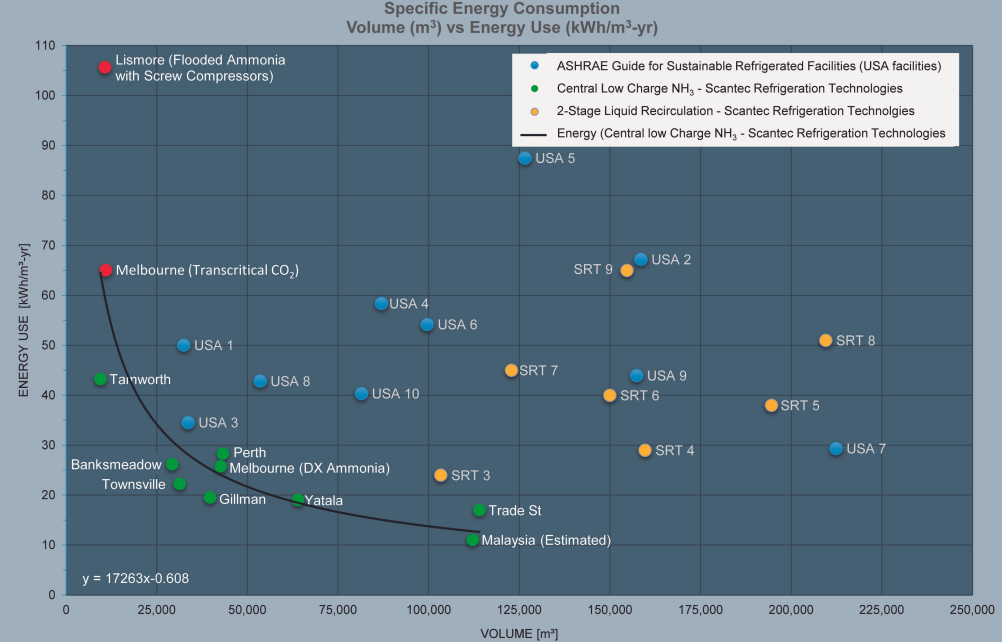
The data shows a clear pattern: performance is not determined by refrigerant alone, but by how the system is controlled.
Where the problem comes from
Traditional ammonia DX systems rely on superheat control in theoretic models and calculations. This creates several challenges:
- High superheat reduces evaporator efficiency
- Water content changes the boiling point and creates false superheat signals
- Liquid carryover risks compressor damage
To avoid these risks, systems were designed conservatively, resulting in inefficient and unstable operation.
|
FACT |
What has changed
Today, direct measurement technologies make it possible to control the evaporation process itself.
Instead of relying on calculated models, the system measures vapor quality directly inside the pipe.
This enables:
- Real-time control of expansion valves
- Improved compressor protection
- Stable operation across varying load conditions
This is not an adjustment. It is a shift in control philosophy.
What this means in practice
A properly designed ammonia DX system delivers:
- Lower refrigerant charge
- No wet suction lines
- Higher energy efficiency
- Reduced system complexity
And importantly: More stable and predictable operation.
Design principles that make it work
Performance depends on correct system design:
- Use vapor quality sensors for direct measurement
- Design evaporators for high gas velocity and low delta T
- Apply modulating compressor capacity control
- Remove water and oil continuously
- Use demand-based defrost to reduce energy consumption
This is practical engineering – not theory.
Conclusion
Ammonia DX systems do not fail because of ammonia.
They fail when they are controlled indirectly.
With the right measurement and control strategy, ammonia becomes one of the most efficient and stable solutions available.
The question is no longer if ammonia DX works.
The question is whether you control your system properly.